November 15, 2009

Overeager, overambitious and underprepared

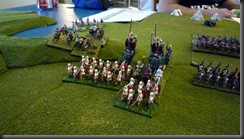
So… more than a year after the decision to start our ‘Age of Arthur’-project, H. and I decided it was time to run our first trial game. The fact that H. had only three finished units against five of mine didn’t bother us – we wanted to get those miniatures out, give them a workout, roll some dices and have a few laughs.

Perhaps a little more serious problem was the fact that last time I had the opportunity to read the rules was… oh, a year ago or something like that. As for the army lists and pre-game preparation – since number of units was so uneven, neither of us bothered with those small details. That’s what the supplements are for!

It will come hardly as a suprise to most of you that our first game was something of a fiasco. Most of the time was spent on trying to find relevant rules, checking stats and similar ‘fun’ activities. By the time we had to start packing up (game took place at local game shop, after opening hours), we did manage to kill one skirmisher and have a successful Saxon cavalry charge, which ended in a draw. This “high watermark” was rather suitable finale of the game.

It has to be said, despite equal fumbling on both sides, we still somehow managed to have a blast. At the same time I think it will be best if we try to avoid games like that and for that reason I have this checklist to complete before next meeting.

  • Read the rulebook
  • Put together an army list
  • Prepare movement trays
  • Ensure that both players have their own set of rulesets for the game

On a side note, even the pictures from the game didn’t work out all that great (starting to be annoyed by my point and shoot, it’s time to get a simple DSL kit). Not that it’s stopping me from posting some pictures anyway. :-)

P1000387
Saxons on the far edge, Romano-British on the near edge

P1000388 Saxon army – two units of foot Duguth,
Duguth on ponies and some skirmishers

P1000389 Anglo-British – two units of milites, one of pedes, mounted commitates
and small ‘special unit’ of foot comitates (Dervel’s Wolftails)

P1000392 Milites brace for impact of Saxon cavalry

P1000393 Commitates try a sneaky flank manover that led to nowhere

P1000397 Saxons smash into milites and get stuck

November 11, 2009

DFF CON 2009

Over two weeks has passed since DFF CON 2009 and it’s about time for me to post couple of words about the show. Let me start with thanking the guys at Dansk Figurspilsforening for an excellent event. Even though I was one of those that arranged a game, my participation was minimal when compared with all the effort that went into all the background work. My participation in Saturday’s games was unfortunately limited to the game I was hosting. I run a slightly modified version of ‘Check Your Six’ scenario called ‘Jolly Good Show’, which I’ve already wrote about in one of my previous posts. The fun thing about this scenario is its replayability – this time around, British players, with help of proper tactics and a huge dose of luck, managed to down four bombers and damage another two for a loss of a single Hurricane. The amazing thing was that they managed to do all that in a single pass through the German formation.

What’s even more important, the scenario was played by a total of six players, five of which never played CY6 before. After three rounds they were ‘self-going’ and, if I am allowed to draw conclusions from the comments, had a really good time.

014Hurricanes passing through
German bomber formation

On Sunday it was my turn to have some fun. First of all, I’ve managed to get my first taste of ‘Fields of Glory’… finally. Couple of the guys at the club are very active with the ruleset and put up a simple 600 points demonstration game with Republican Romans and Phyrric Greeks. Things went according to the plan – Phyrrus’ elephants created mayhem on one of my flanks, cavalry danced around on the other, and in the middle Roman legions gave the Greeks a bloody nose… or at least they were in process of, because we had to finish just as things got interesting (some blokes needed the table :-( ).

006 Phyrrus elephants trample Spanish mercenaries

009 Roman legions clash with Greek phalanx

Even though my first game was untimely interrupted, the rules set gave me a very positive impression. It is rather complex and the game itself takes its time, but the game mechanics do look sound and I had fun while playing. This first impression was rather important to me, as I am in the middle of painting a rather large Greek army.

Next on the schedule was a naval action with ‘Fleet Action Imminent’. It was great game - two British battlecruisers exploded and another managed to get shot to pieces… unfortunately, I was on the British side, so I won’t write much more about that event. :-) However, despite bearing witness to a small British disaster, I have to say that ‘FAI’ is growing on me. Simple, quick to learn and yet manages to deliver realistic results – that’s the kind of ruleset that I like to play these days.

All in all, more than 10 hours gaming time over a weekend, it’s been a long time since the last time that happened. Already looking forward to DFF CON 2010.

Couple of snapshots of some of the other DFF CON 2010 games.

001 Start setup for an I Ain’t Been Shot Yet, Mom’ game.

003
Demonstration game of ‘From Valmy To Waterloo’…
WITH THE AUTHOR OF THE RULESET! :-)

010
‘Ambush Alley’ game.

011
Closeup of same game.

012
Colonial skirmish game… I think.

October 25, 2009

Back to Albert Canal

Call it for artistic drive or pure silliness on the part of the owner of this blog, but for quite long time I had a wish to write an after action report in narrative style, rather than a dry description of the moves, dice rolls and game mechanics. I finally did it in post “Battles over Albert Canal” and I have to say that I’m a little surprised over how hard it was. Still, some people enjoyed my first attempt at “writer’s career”, so I may do it again sometime.

However, for the sake of consistency, I do feel that I need to post a more traditional AAR of that game. So, what did really happened that day? Scenario for the game was taken from "Over The Channel - Battle of Britain" scenario book for Check Your Six. It’s called “Impossible Mission” and considering the real historical events it is based upon, it’s a very appropriate title. Six Fairey Battles escorted by two Vic- formations of Hurricanes attempt to bomb a bridge over Albert Canal. German side has six Me-109:s on patrol and the bridge itself is protected by light anti-aircraft artillery.

In our game, L. controlled German fighters, while F. and W. took control of escorting Hurricanes. I took charge of five apparently doomed Battles (we lost one in pre-game event check). At the start of the game, German fighters were spread over the table in three rote-formations, so British plan was to take advantage of that fact, get to the bridge as quickly as possible and then get out of Dodge.

Naturally, Battles were like the big magnet for Me-109, which started to close on them from three different directions. Hurricanes hastened to meet them and leader of W’s fighter formation managed to score hits on leader of one of German rotes in a head on attack. Unfortunately, the German pilot managed to return the favor – so one fighter on each side was out of the fight. Remaining fighters of those formations tangled with each other for the rest of the game, but none of the sides managed to score any hits.

Another German rote closed on the bombers from the opposite side, initially bypassing F’s Hurricanes. F. managed his planes in skillful manner and managed to place them in tailing position behind the Messerschmitts. L. disregarded the danger and pressed on his attack on the Battles. His effort was rewarded and one of Battles went down immediately, after a critical hit was scored by the leader of the German flight. His joy was however rather short-lived, since in subsequent turn his leader was shot down by the Hurricanes and wingman’s airplane suffered engine damage from a well-aimed burst from a Lewis machine-gun of leading Battle. He tried to escape, but was finished off by F’s Hurricanes in subsequent turn. Unfortunately, two of victorious British fighters expended their ammunition and were forced to head for home.

As the Battles got close to the bridge, last German rote caught up with them. Leader of this flight was the best pilot in the air that day and it showed – his opening salvo resulted in one Battle immediately shot down (once again, critical hits from the 20mm cannons), while a subsequent burst scored damaging hits on another Battle. Fortunately, he didn’t manage to do more damage before passing behind the British bombers and encountering remaining Hurricanes. Three surviving bombers reached the bridge and unaffected by ineffective AA fire, dropped their bomb load on the bridge. One of those was a direct hit, severely damaging the target.

Then “the freak event” of the day occurred – L. attempted to extract his fighters from the chaotic fighter furball behind the bombers (four planes in a single hex) and attempted an Immelman with two of his Me-109. Since both planes made same maneuver, they ended up yet another time in same hex and this time they collided with each other. Both planes managed to stay in the air, but with bombers reaching their target and only a single German plan in fighting condition we decided to call it a day.

End result was a brilliant British victory – bridge severly damaged, 2 German fighters shot down, while three other were damaged. Price for that victory was paid by two downed Battles. Point total for the scenario was 24 points for RAF and 8 points for Luftwaffe. Campaign total after the game is 54 points for RAF against 27 for Luftwaffe.

Historical background for this scenario can be found here.

Finally, a couple of words regariding the "Check Your Six" ruleset - to put it bluntly, it is without a doubt my current absolute favorite ruleset in all categories. It is easy to learn, very intuitive and immensly fun to play. However, there is an apparent upper limit of number of airplanes that a single player can handle. Two planes per player is perfect, six is an absolute maximium in my opinion. Also, once multiple airplanes get into same area, things can get rather complicated and tempo of the game slows down significantly. To counter possible confusion, I will in the future use color coding directly on the airplane bases for several aspects of the game.

October 15, 2009

DFFCon 2009 at Tøjhusmuseet will take place next weekend

Just a short notice about a historical wargames convention DFFCon 2009, that will take place on 24-25 October. This rather unique event for Scandinavia is arranged by Dansk Figurspilsforening at Tøjhusmuseet (Weapon Museum). Detailed information about the convention can be found here. Yours truly will be arranging a “Check Your Six” participation game on Saturday.

Wargamer's haven in Copenhagen

Considering the fact that this is probably the most significant wargaming event in recent years for me, I must say that this post is long overdue. OK, “most significant” may sound over-dramatic, but how else would you describe the fact that there is a very active historical wargaming club in the city where you are practically every day?

So what am I babbling about? Dansk Figurspilsforening in Copenhagen of course. The ironic thing is that I’ve known about their homepage for years, I even used some of their gorgeous flags for some of my ACW units, but the idea to visit the club never entered my head. Fortunately I came into contact with one of the members on TMP and the rest is history.

The club has activities every Wednesday from 1800 to late evening and the range of periods and rulesets that are used is quite mind-boggling. Larger games are also played on weekends, but those are one-offs events. There are two large tables available for games and complete sets of modular terrain available for the gaming pleasure of the members. In short, if you ever visit Copenhagen and are keen on a game, Dansk Figurspilsforening is the place to visit.

August 30, 2009

Adler ACW range review redux - part 5

What do they say... oh, yes, road to hell is paved with good intentions. I was hoping that after first week of my vacation I would be done both with my first Spartan unit for Fields of Glory and perhaps even with that beautiful Wolftail Band for my WAB Arthurians. As it is, I still have quite a lot of work left on my Spartans and Wolftails... well, let's not talk about them at this moment.

So, I am forced to re-run some old material - here's next part of my review of Adler ACW range. While I'm fully aware that it's a silly criterion, for review purpose I'm dividing Adler's miniatures into Union and Confederate miniatures based on the headwear type on their heads. Thus minis with kepis can be found in part one and minis with hats are reviewed below.

Of course I'm not using this principle when painting Confederate units. Right or wrong, I like my Confederates to have more irregular look than their Union counterparts. For that reason in I mix freely all minis available from Adler.

Adler Miniatures ACW range - strips ACW3A/XACW4
Strips with number 3 are basically same as 1 and 2, except for the fact that miniatures wear hats instead of kepis. Strip 3A has four miniatures with firing stance. Strips XACW3 and XACW4 can be used to achieve more animated units.

ACW3A - Hat, firing, blanket roll.

XACW4 - infantry, hat, loading.

Confederate regiment ready to fire.

Yes, they still look silly when in column formation.

August 25, 2009

Battles over Albert Canal

With red arrows piercing the blue lines at several locations, the picture shown on the operational map looked rather depressing. If anybody was still doubting it, one look at that map was enough to tell him that the “Phoney War” was over and Jerry was on the move.

Quiet murmur of plane crews discussing the events of the last couple of days quickly died out as Captain Richards, wing operations officer walked into the tent. He walked to the map, turned around and hesitated for a moment as he observed the men in front of him. “They look so tired.” – he thought and immediately felt his own exhaustion. He then cleared his throat and started today’s briefing.

“Gentlemen, as you are well aware, the situation at the front is not developing to our satisfaction. Despite best effort of our ground forces, Jerry managed to cross the Meuse and is pushing into Belgium as we speak. HQ would like to do something about it and has ordered RAF to take out the bridges at Albert Canal.

Your squadron will participate with six airplanes. You will be escorted by two sections of Hurricanes. Expect heavy opposition – there is substantial Luftwaffe presence over the Canal and intelligence reports indicate heavy ack-ack defenses in the target area.

We will be lifting of at…”


Flying Officer Henry Stevens anxiously scanned the skies, searching for the dark specks signaling presence of enemy fighters. So far they managed to avoid the attention of the yellow-nosed bastards, but he knew that it was unlikely that their luck would hold all the way through the mission.

He looked to the sides for yet another check of the formation. He could clearly see the pilots of two Battles in his section, their heads turning from side to side as they looked for the enemy. He couldn’t find the Hurricanes, but he knew that they were there – two Victor formations, behind and above his flight. “At least Jerry won’t be having free lunch today.” – he thought.


Initial setup.

He looked forward again and there it was – a silvery blue band of water cutting through the mostly green landscape. He followed the dark grey line of the road and found the spot where it intersected with the Canal. Their target was barely visible from this distance, but the hazy contour of the bridge was enough for him to feel the pang of excitement mixed with fear.

He pushed the radio button and said: “Target in sight. Form on formation leader. Change altitude to 400 feet.”

He put his plane into a shallow dive, felt the Battle accelerate and watched his wingmen disappear behind him. The plan was to approach the target in single file formation at very low altitude. Hopefully, the speed gained by the dive and low level of the flight would counter the anti-air artillery defending the bridge.

“This is Red One. Enemy fighters at two o’clock high! Engaging!”

Head-on pass of Red One.

Stevens had hardly time to find the two… no, four dots rapidly moving in his direction before the radio crackled again - “This is Blue One. Bandits at ten o’clock high. Breaking formation to engage!”. Stevens snapped his head to the left, but had at first difficulty finding the enemy fighters spotted by the Hurricane pilot. When he finally saw the German planes, they were no longer small specks in the sky, he now could see their wings.

He quickly checked his instruments and then looked for the target - he could now see the trees at the banks of the channel – before looking to the right again, just in time to see the tracers sprouting from two fighter formations approaching each other on collision course. Was it fire coming from one of the planes?

Rapid staccato of strained voices now came out of the radio.
-“Blue One. I’m hit! Returning to base!”
-”Blue Two. Blue One, you got him, bastard is smoking! Engaging the rest of bandits!”
-“Red One. Bombers, enemy planes on your left. Repeat, enemy closing on your left!”


German fighters approaching Battles, Hurricanes in pursuit.

That last sentence made Stevens snap his head to the left. It wasn’t difficult to find the enemy, those two Me109:s seemed to be right on top of him. Just a split second later he saw glowing fireballs spitting out of their wings, flying straight at him.

-“Green Two, I’m damaged. Can’t control he….” – the voice cut off before finishing the sentence. Green Two, that was his number two wingman, Henley. Stevens involuntarily tightened his grip on the stick as he heard the strangely high-pitched voice of his rear gunner shouting “Oh, my God!” on the intercom.


Death of Green 2.

It was with grim satisfaction that Stevens watched the effect of the fire comming from the Hurricanes that pursued the German fighters. Tracers seemed to embrace the leading Messerschmitt and large chunks separated from its airframe as it closed the distance with the Battles. For a second, Stevens was mesmerized by the sight of the stricken enemy fighter visibly stagger in its path, then pitching over into a shallow dive and heading for the ground. Next, rattle of his rear gunner’s machine gun pierced through the monotonous sound of the engine, snapping him out of his fixation on the seemingly mortally wounded Me109.

The bridge was now just a couple of kilometers away and he made last routine check of the instruments. Suddenly multiple fingers of tracers reached out toward him – yes, for once the intel was correct, a lot of ack-ack down there and they all seemed to focus on his plane. He pushed the grim thoughts out of his head and concentrated on the quickly approaching bridge. He heard his gunner shouting intelligibly with excitement on the radio. Then a Me-109 passed his Battle just couple of hundred yards away, its engine engulfed in flames. It disappeared below him, as suddenly as it appeared. Later he found out that Jenkins actually managed to damage the enemy airplane with his puny Vickers machine-gun and Hurricanes swiftly finished it off.

Bridge was straight ahead now. Just a couple seconds more….

Green One bombing the bridge.

“Releasing bombs!” – Nick Doyle, his bombardier confirmed what Stevens already knew, as he felt the Battle jerk up once it was released of its bomb cargo. Then he heard Doyle shouting “Direct hit!”. Sense of satisfaction replaced for the moment the dread that Stevens felt ever since the Messerschmitts were spotted.

That feeling lasted just for a second– Stevens kept his low altitude and banked the Battle to the right. As he banked the plane, he could see the horrifying spectacle above the bridge. Somehow he managed to get several hundreds of yards in front of his squadron – remaining Battles reached the bridge only now. Just before they reached the target, a pair of yellow-nosed 109 reached them and raked the bombers. Stevens’ face twisted in helpless fury as he saw the bullets tearing into two of the Battles, literally ripping one of them into pieces. The other one started to smoke, but stayed on course. Two surviving Battles released the bombs just a moment later, both missing the target with couple of yards.

What followed next stunned both Stevens and apparently everybody else. Two Hurricanes appeared behind the Me-109:s that annihilated the Battle just a second before and for a moment Stevens could hardly distinguish friend from foe. Then both German planes took advantage of their speed and rose up in the air, performing textbook Immelmans. Stevens observed them arching up in the sky, coming closer and closer together… and finally colliding with each other! The Messerschmitts seemed to bounce of each other, creating a cloud of debris at the point of impact, but amazingly both planes stayed in the air.

Bombing run of remaining Battles.


This rather unexpected event seemed to take the spirit out of the Germans. Anti-air fire slackened for a moment, crews of the guns probably being afraid to hit their own fighters. Surviving British airplanes took this opportunity to extricate themselves from the area. Stevens continued to wearily observe the German planes for a long while. As it turned out, he didn’t have to. Remaining 109:s seemed more interested in nursing their damaged comrades back to the base, rather than following the bombers that already did all the damage they could manage.


Stevens felt empty inside. “We did what you asked us, now make it count.” – he thought as he threw last glance at the black columns of smoke marking the graves of his comrades - “Make it count!”.