November 14, 2015

Review of “Seven Firefights in Vietnam” by J.A. Cash, J. Albright and A.W. Sandstrum

516j4MdO4lL._SY344_BO1,204,203,200_

”Seven Firefights in Vietnam” is a collection of seven reports describing specific combat actions in Vietnam that took place between 1965 and 1968. Five of the reports deal with engagements involving forces of battalion size, one describes an ambush by a mere squad, while the final chapter is dedicated to a fire support mission by an element of two Huey helicopters configured as fire-support birds.

The narrative is consistently of ‘after action report’ variety – brief, strictly descriptive, no dialogs or deeper analysis of events or decisions. Orders are given, units maneuver here or there, engage the enemy, fire is exchanged, casualties taken… rewind and repeat. While the writing style is definitely austere, the authors manage to give a pretty clear picture of chain of events and character of individual engagements. If that’s what the reader wants from this book, then he will be satisfied. If reader’s expectations go beyond mere report of events, then I’m afraid that this book will turn out to be something of a disappointment.

Selection of after action reports included in this volume is also something of a problem. The first of them, which is also the longest one, deals with battle at Ia Drang, made famous by the “fantasy” movie “We were soldiers once” couple of years ago. It’s inclusion in this volume is perhaps the most logical, since it was a first action involving air-mobile unit of battalion size and something of a test of the concept that has later become synonymous with Vietnam war. The narrative of action at Dak To in 1967 where a battalion size search & destroy mission was hit by a Vietnamese ambush seems also to be quite representative for combat actions of that conflict. The rest of this book is however something of a mystery for me. Remaining chapters describe an ambush against a large vehicle convoy with AVAC squadron acting as escorts, a huge battle between riverine units and extremely well-entrenched opposition, a small scale night ambush by a single squad, an assault against a major firebase which is not only successful but in which the Vietnamese use a company of tanks (!!!) and finally a fire support mission by a couple of ‘Hogs’. This selection surely provides a lot of diversity, but it also makes it very hard for me to understand the purpose of this book.

A reader genuinely interested in and already knowledgeable about Vietnam conflict will find a lot of interesting material in this book. For remaining audience it will probably be a very dry and ultimately unsatisfactory book.

For a wargamer, “Seven Firefights in Vietnam” is however a must buy, if one’s interested in Vietnam conflict. Each of five large engagements covered in the volume will easily provide material for a large reinforced battalion-size scenario. If split into smaller components, each of those chapters can be split into several company-size or even mass skirmish games. There are however two weak spots – the maps included in the book are inadequate and scenario designers will have to make their research. Also, the Vietnamese OOB:s are very rudimentary. This in itself is hardly surprising – the volume was first printed in 1970, while the conflict was still ongoing. But it’s a bit annoying nevertheless, because I doubt there are many books about Vietnam conflict that also resemble scenario books so closely as this little book!

November 12, 2015

New recruits for Dux Britanniarum

Some of you perhaps remember the budding ‘Dux Britanniarum’ campaign that I and H. started about two years ago. Last encounter took place about a year ago, but neither the campaign nor the ruleset has been forgotten by me. Unfortunately, real life pushed itself in repeatedly into both mine and H.’s life and it will probaly be a while before next clash between his Saxons and my Britons.

Luckily though, a number of my buddies expressed a desire to try their luck as Saxon warlordings looking for better life on British shores. There was only one problem – H. controls his Saxons with an iron hand and won’t allow anybody to lead them in battle. Thus, the only way to enable my other friends to be bashed and sent packing by my Britons was to paint up a bunch of Saxons they could lead to the inevitable slaughter.

As always, buying the miniatures is only the first step. Next, they have to be painted and it took me forever to get going with this project. Now however the first bunch is ready and spoiling for their first visit to British Isles.

Couple of words about the miniatures – this lot was bought from a company formerly known as Musketeer Miniatures. These days though the company calls itself Footsore Miniatures. Absolutely lovely minis they are and a pure joy to paint. Recommended without any reservations!

EarlySaxons_Batch_I_010

EarlySaxons_Batch_I_014

EarlySaxons_Batch_I_016

November 04, 2015

C4 Open 2015–Part II

Second and last part of pictures from this year’s C4 Open exhibition. Hope you like them.


October 24, 2015

C4 Open 2015–Part I

The thing called ‘real life’ managed yet again to put all things wargame-related onto a backburner. Thus no posts over last couple of months. However, time nevertheless keeps moving forward and we’ve now arrived to the last weekend in October, which means… yes, you’re right – that today it was yet again time for the annual model kit exhibition in my area.
Model kits and wargaming are two different hobbies, but there is a lot of overlapping between those two. For me personally, both hobbies are really just an extension of my interest in military history. And that’s why, yet again, I’m now posting a bunch of pictures from the exhibition. First up, all the airplanes.
Hope you’ll enjoy the pictures as much as I enjoyed the exhibition. Ler

September 06, 2015

First taste of Charlie Don’t Surf

And so, more than two years after I decided to dive into this project, the day finally arrived – yesterday, I’ve run my first game with ‘Charlie Don’t Surf’, Too Fat Lardies’ company level ruleset for Vietnam war. T. took charge of Americans, L. run the local VC forces, while yours truly took upon the ungrateful role of game-master.

While ‘Charlie Don’t Surf’ has a full-fledged scenario generator, I’ve decided to keep things to bare minimum for this first try and put together a simple scenario without any bells and whistles – a reduced strength U.S. company with 3 x platoons with two squads each and a weapon platoon of two M60’s was to perform a search of a village suspected to contain a VC store. Local VC company of two platoons (3 squads each), an MG and a recoilless rifle stood for the opposition.

The game

Once again, I’ll rely on the pictures for the ‘meat’ in the AAR, with supplementary text providing the details. Quick comment about the pictures; for this first game I wanted as little distractions as possible, so I didn’t take any pictures while it played out. Instead, the pictures were ‘arranged’ today, while my memory of the game was still fresh. Mistakes were however committed, the most serious one consisting of me forgetting to deploy MG bases that were attached to two of U.S. squads, thereby augmenting their firepower. Furthermore, I didn’t bother with placing the ‘shock’, ‘pin’ or ‘suppression’ markers that were present during the game.

CDS_Test_Game1_02

The picture above shows the terrain where the engagement took place. Once again, with goal of keeping things as simple as possible, the jungle was designated as ‘light terrain’. Clumps of vegetation are also ‘light terrain’ although they do block LOS. Elephant grass is designated in CDS as ‘light terrain’, but I’ve read multiple personal memoirs of how exhausting it was to get through them, so until further notice I’ll regard it as ‘hard terrain’.  Rice paddies, hills and houses are self-explanatory.

The game started with L. deploying his forces. 1:st platoon and recoilless rifle took up position in the woods and on the height above the village. 2:nd platoon was deployed in the woods on the other side of the road, while the machine gun was placed on the height nearby, guarding the flank (I guess).

In CDS, units of platoon size initially have to be placed under so called ‘blinds’, effectively disguising the type and strength of the units. Furthermore, each terrain feature can act as a ‘blind’, thereby making units placed in such manner totally hidden – so in our game, initially there was no indication of 1st platoon and recoilless rifle at the beginning of our game.

Additionally, each side has the right to deploy a number of dummy blinds. Number of such dummies varies depending on ‘fraction’, with local VC being the extreme case. They’re authorised to deploy one dummy blind for each real unit in their OOB. Transparent red rectangles indicate where L deployed his dummies (although I do believe there weren’t as many as in the picture! :-).

Finally, L. marked a grand total of five tunnel entries on the board, or rather on a snapshot of the board I took before the game and printed out for this very purpose; isn’t modern technology grand?!! Four of those secret entries were in the area where his 1st platoon was hidden. One entry was placed just beside the lone house near the road.

With L. ready to receive his ‘guests’, we were ready to start! Events of initial four or five rounds are shown in the picture – T. entered the board from the right, with two platoons above the road and one below. T. had to spend some time on spotting and removing of fake blinds L. placed in path of his advance. This was done without problems, but T. had to disclose content of his own blinds while doing it – false blinds can spot as well as real ones!
CDS_Test_Game1_05

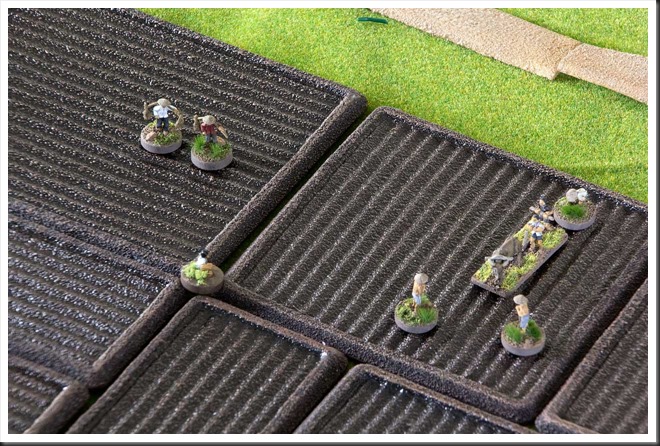
Meanwhile, the local villagers minded their own business, doing their best to ignore American patrol.

CDS_Test_Game1_12

Contact! In fifth round, L. took advantage of the fact that T.’s 1:st platoon came into close range of his own 1:st platoon hidden in the woods at the end of the turn. This gave him the right to open fire and he blasted forward squad of T’s exposed platoon with massed fire from two squads that were in range. This could have had fatal consequences, but luckily for T., L.’s ‘famous’ bad luck with dices restricted the casualties to one KIA and some ‘shock’ points.

CDS_Test_Game1_13

T.’s luck held in round that followed, with his 1:st platoon being activated before its assailants. His return fire managed to cause several ‘shock’ points on one of VC squads, but no casualties. Next, he called on 2:nd platoon for support – the rushed at top speed into the woods, their goal clearly being the flank of VC position.

L. had opportunity to continue the engagement, but decided that discretion was the better part of the valour. When his platoon was activated later in same turn, he broke contact and directed his troops to the tunnel entrance conveniently placed behind his position. In subsequent round T. managed to drop one of the retreating opponents , but that was all he managed to achieve before the VC platoon disappeared from sight.

CDS_Test_Game1_15

With VC vanishing into thin air, T.’s 1:st platoon headed for the edge of village. As soon as one of the squads got inside the hutch, L.’s recoilless rifle pumped couple of 57mm shells into it. Yet again, the results of the fire were limited to couple of points of ‘shock’, although one of the civilians taking cover inside the hutch was instantly killed.

T:s response was rapid and similar to that of the reaction to the initial VC attack – concentrated fire from two squads suppressed the gun’s crew and caused two casualties. Next, 2:nd platoon came into firing position, opened up and killed two more crew members. With single VC soldier remaining standing, we removed the gun from the play, even though there are rules in CDS for handling such situations with a bit more detail.

This ended the game in this sector, even though T. took advantage of the lull in combat and tested the rules for interrogation of civilians. The peasant in question was however, as the ruleset expressed it, ‘not interested in conversation’. :-D

CDS_Test_Game1_17

Meanwhile on the other side of the road, T.:s 3rd platoon advanced slowly forward against one of L.’s dummy blinds after another, until they unwittingly got in range of L.’s hidden machine gun. It opened up on one of the squads and managed to kill one American soldier before extremly effective return fire from his comrades almost instantly eliminated machine gun’s crew to the last man.

With 1:st VC platoon skulking in the tunnels and 2:nd never being able to get into position, we decided that it was quite enough excitement for this time and called it a night.

Musings after the battle

What did the ‘combatants’ think of this first experience with ‘Charlie Don’t Surf’? Well… T. has never been a big fan of rulesets from Too Fat Lardies and ‘I Ain’t Been Shot Yet, Mom’ in particular has become something of his pet peeve during the years when we used it for our WWII games. So, considering the fact that CDS is a derivative of IABSM, it’s hardly surprising that his impression of the ruleset was lukewarm. As far as I understood it, his initial opinion could be summarised with single word –overcomplicated.

L.’s initial impression, while restrained due to the basic character of the scenario, was definitely more positive.

As for me, the goal of this game was for me quite simple and clear – I wanted to get familiar the core rules for command and control of troops, basic infantry combat mechanics, and if we managed it, get a taste of some of the rules specifically designed to handle peculiarities of Vietnam conflict. I feel that this little scenario gave me what I was looking for, but at the same time it hadn’t provided me with enough ‘data’ to form a definite opinion about the ruleset. Of course it won’t stop me from writing another, more detailed post about my initial thoughts of ‘Charlie Don’t Surf’ in next couple of days, so stay tuned! :-)

August 30, 2015

In a spur of a moment, or DIY dice trays

So… yesterday I had to make a trip to Systrerne Grene, this peculiar shop with all sorts of cute paper bags, boxes, ‘nice smells’ products, frames, decoupage stuff and dozens, if not hundreds of products that women seem to love to use for that ‘personal touch’. It’s the same place where I found those beautiful transparent plexiglas boxes perfect for my 6mm figures (which by the way have since been withdrawn from their product range Ledsen).

Anyway… as I walked through the shop, this item caught my eye.

Dice_Trays01

The thing is made out of cheap, lightweight wood and plywood and costs 40SEK, which if I am to be perfectly honest, is a bit steep! I have no idea what the original idea for this thing really is, probably some sort of display box.  But I am pretty sure that any wargamer worth his name will immediately have two words popping up in his head when he sees something like this – dice tray! Needless to say, two of these thingies immediately found themselves in my shopping cart.

Today, I gave the ‘trays’ a closer look and came to the conclusion that I wasn’t entirely happy with them. They’re quite shoddy, with very thin bottom and these stripes look a little bit weird. There was definitely room for improvement and luckily I had all I needed at home.

Dice_Trays02

First, I grabbed some wood stainer left over from another project and darkened the frame. I then left the trays outside (stainer smell is just plain awful!) to dry for several hours.

Next, it was time to do something about that ‘striped’ bottom. Lining of some sort was the apparent solution here and what do you know, I happened to have some leftover dark-green felt that fit the job! As for how to fix it into place, the choice was between white glue and spray glue. I decided to give the second option a try.

Dice_Trays03

Cutting the felt to size was the biggest challenge in this little project. I tried to measure and cut the felt to size, in two attempts the hexagonal shape turned out to be both irregular and too small. I then changed my approach and cut out an oversized piece of cloth. Next I sprayed the glue on it and pressed it into place. I paid extra attention to the edges, pressing the cloth into the ‘angle’ with the backside of hobby knife.

Dice_Trays04

Once the felt fit snuggly in place, I started cutting off the ‘surplus’, one hexagon side at a time. I tried to follow the ‘angle’ of the tray as closely as possible, but the end result wasn’t 100 per cent perfect. With practice I am sure that I would achieve the ‘professional’ look, but life’s too short for perfection.

Dice_Trays05

And so, here they are – two large hexagonal dice trays. Total price, a bit over 80 SEK, time expenditure – maybe an hour. What’s not to like! Ler

August 25, 2015

Silicone roads from Total Battle Miniatures

Well, it seems that two things have came here to stay – a complete dry spell when it comes to games and me being stuck with one terrain-related project after another.

Luckily, in this case, it was ‘quick and painless’. As I’ve mentioned on a couple of earlier occasions, one of the things I find really tiresome with those hex tiles from GHQ is the fact that as soon as you make some type of terrain, you need to make a bunch of extra road tiles.

The solution? Why, flexible roads of some sort, of course. Several companies offer this product these days, but since I like the stuff that guys at Total Battle Miniatures, I decided to go with their variant.

The initial batch I’ve ordered is perfect for 6mm – they’re two centimetre wide, long straight bits are thirty centimetre long and there is an assortment of curves, crossroads and T-sections which allow you to quickly set up whatever road system you require. Preparation is dead simple – wash the strips in soapy lukewarm water, leave to dry and drybrush with acrylic paint. I used three shades of wall paint – dark brown mid-brown and cream for highlights. The paint doesn’t really ‘stick’ to the silicone and can be peeled off quite easily, but with an occasional touch-up I should be just fine.

P1010752P1010754P1010756P1010762