April 27, 2013

When in doubt, start a new project

To say that my wargaming has for a while now been placed in low priority department would be something of an understatement. Between rather hectic tempo at work, my re-kindled interest in proper model kit making and plain lack of enthusiasm, so far during 2013 I’ve barley managed to pick up a brush, much less to participate in a game.

I’m pretty sure that we all have those ‘low intensity’ spells. The question is what to do to get out of them. In this particular case, I’ve decided to give “new project”-method a go. After all, whatever I have on my plate at the moment (surprisingly short list, now that I think about it – some 6mm Napoleonics, couple of 1/600 airplanes for my flagging Check Your Six Battle of Britain project and couple of terrain hexagons for a Shiloh scenario setup that was supposed to be ready last year) obviously fails to attract my attention. And that’s why I’ve decided to take the plunge into Vietnam era.

Vietnam has always been a war that was very interesting to me and ever since Too Fat Lardies released ‘Charlie Don’t Surf’, the call of the sirens was almost irresistible. There was however one huge speedbump that until now always managed managed to stave my enthusiasm – jungle terrain. I’m a decent figure painter, but when it comes to terrain I’m not only quite inexperienced, I also don’t enjoy that part of the hobby all that much. Thus, jungle terrain always seemed beyond my skill as well as my attention span.

Nonetheless, over last couple of weeks I did a bit of research and convinced myself that I should give it a try. Getting the ruleset was the fist step. Next, I’ve ordered a bunch of palms and trees from some Chinese outfit on Ebay. They arrived at my doorstep couple of days ago and considering the price, they’re excellent. Today it was time to take the next step and find some additional vegetation – in other words a trip to IKEA was in order. Yepp, you read correctly, whenever you need something for your wargaming table, IKEA is the place to visit. After a bit of recon I found three types of fake plants that fit the bill. An added bonus consisted of the fact that just a stone throw from my local IKEA there is a huge shop with all sorts of garden plants, including fake ones. A quick visit there resulted in a great find - two rather odd looking balls of grass which look rather useful for my purpose. In total, five different types of shrubs and plants for less than 200SEK.

Now all I need to do is to figure out how to turn them into Ia Drang valley.


IMG_1196Today’s loot. Completely confused Spartan hoplites
are present for the sake of scale perception.

March 29, 2013

Tinkering with General de Brigade

Sorry guys, unfortunately this is not another after-action report, but a rather lengthy rant about the ruleset itself and why, in my humble opinion, it is not The Holy Grail of Napoleonic period rulesets.

The good…

In many respects, General de Brigade is an excellent ruleset, especially if you like a strong whiff of traditional approach to game mechanics. There really isn’t anything surprising or revolutionary in it, as the turn sequence clearly indicates – initiative roll decides who is the ‘phasing’ player (i.e. has precedence in certain phases of the turn), followed by compulsory movement (routes, pursuits and such), attempts to change brigade orders, charge declarations/moves, normal movement, firing, melee and finally morale checks where necessary. Once done, rewind and repeat until a conclusion is reached.

Traditional thinking expresses itself in other ways. Both firing and melees are accomplished with 2D6 dice rolls subsequently being adjusted by a bunch of modifiers. Final outcomes are looked up on tables providing the casualty numbers alternatively results of the melee. While there is nothing innovative in this approach, I do like it (well, to a degree, see below) mainly because it allows for an approximate estimation of casualty rates. This in turn allows the player to actually plan his assault and defence and allocate forces necessary for accomplishment of a specific task.

Charges are a bit fiddly, but on the other hand I am yet to encounter a ruleset that handles this aspect of the battle in a smooth way. On the positive side, anyone familiar with Napoleonic period will understand why charge procedure works the way it does in GdeB.

GdeB’s handling of skirmishers needs to get an honorary mention. Rules governing this troop class are very simple and yet, they manage to reflect perfectly role of skirmishers during that period. What’s perhaps even more important, those simple rules also manage to reflect differences in skirmish doctrine of different nationalities in a way that actually has real impact on the ‘battlefield’.

the bad…

In my opinion, most rulesets can be described as either ‘historical’ or ‘gamey’. I’m sure other wargamers have different definitions for those words. For me, a ‘historical’ ruleset can be recognized by its more or less uncompromised adherence to history, even if it influences the game experience in negative way. ‘Harpoon’ is a perfect example of such a ruleset. A ‘gamey’ ruleset focuses on the other hand foremost on the game experience. History component in such rulesets is used to provide the flavour, but isn’t much of a speed-bump when creator’s ‘artistic freedom’ needs to flex its muscles (dare I use ‘Flames of War’ as an example for that type of ruleset?).

General de Brigade is a strange mix of those two styles. In some respects (order system, command&control, restrictions of brigade system, charge mechanism) it is obvious that author tried very hard to transfer the reality of Napoleonic period battlefield onto the tabletop. But at the same time, other aspects of the ruleset are surprisingly ‘gamey’.

The most evident example of ‘gamey’ approach is without a doubt the ‘Dispersal Point’. In it's entirety, this game mechanism is a fair bit more complex, but it essentially means that units that have suffered 50%+ casualties are to be automatically removed from the battlefield. Let’s disregard the historical implications of that rule, although it is quite amusing to wonder over how Napoleon would react if one of his marshals told him ‘Sir, this or that battalion has now lost half its strength, so it will be leaving the battle line now, if you don’t mind.’. My main objection to this approach to unit breaking due to excessive casualties is directed against its deterministic character and how it influences the players during the ‘battle’. If I know that a unit will literally disappear when it reaches a predetermined ratio of casualties, I will play in a way that will achieve that goal. That’s where ‘gamey’ factor enters the picture in my opinion. Real commanders didn’t think in such way, simply because there is no nicely predetermined “breakage point” on a real battlefield.

Same gamey approach can also be found in rules for melee, where number of casualties is predetermined by number and unit type of participants. A player can therefore calculate in advance exactly how big his casualties will be in any melee. Considering the chaotic nature of melee, that is a very generous approach to this aspect of the game.

My problem with both of those mechanisms is, as already indicated, caused by the blanket of certainty they provide to the players. I will therefore try to ‘muddle the water’ a bit in coming games with couple of house rules. In regard of melee casualty rates, I’m toying with the idea of opposing die rolls that will modify those neatly predetermined numbers. For example, the ruleset says that in a basic infantry melee the winning side inflicts 1 casualty per 6 figures, while losers inflict 1 casualty per 12 figures. An opposed die roll with D4 could then be applied to casualty rates of both sides, thus providing a spread of -3 to 3 random modifier to the butcher’s bill. Elite troops could roll with D6 dice, giving them additional punch in shock combat.

Dealing with ‘dispersion point’ is a bit more difficult and I still haven’t come up with a house rule that I like. To be fair, it has to be said that individual battalions are quite resilient in GdeB and automatic removal of units with 50%+ casualties certainly does speed up the game. But as I mentioned before, the deterministic character of this rule really bothers me and I will have to do something about it.

and the ‘meeh’

If there is a single section of the ruleset that I really don’t like, then it’s the rules that govern the risk to general officers. Basically, they are toothless. Possibility of something bad happening to a commanding officer is triggered by a result of double sixes in any dice roll used for resolution of fire or melee. Thus, statistically, a chance for a bad thing happening is 1 in 36, a very low probability indeed. Another roll with two D6 is then required to determine nature of the event. What I don’t understand is why, considering the already low probability of ‘bad things’ happening to officers, about 30% of results on effect table has no effect whatsoever!

Another issue that I have with this mechanism is in its inability to deal with high risk decision of placing commanding officers in front of the troops. Leading from the front has always been regarded as noble and brave… and for a very good and rather obvious reason! Not so in ‘General de Brigade’ though. Letting brigade commanders to lead troops charging into a melee is in my opinion a no-brainer, simply because additional bonus in charge morale checks heavily outweighs possibility of them ‘buying the farm’ due to a random double six. Just to illustrate the inadequacy of this method, I’d like to remind the reader of a situation in my game where a French battalion suffered 10 out of 26 figures in casualties during a single melee. That’s  more than one soldier in three. Needless to say, the brigade commander who led them from the front didn’t even get a scratch during that engagement.

Final thoughts

Let me be clear on one point - don’t let my critique give you the impression that General de Brigade is a bad ruleset. My opinion is in fact quite opposite – it is apparent that a lot of thought was dedicated to it being able to realistically recreate a Napoleonic battle at battalion/brigade level. However, there are in my opinion certain aspects in this ruleset that are  ‘compromised’ for the sake of the gameplay. Some may live with it, others will feel the need to ‘correct’ this or that aspect of the game. After all, that’s the beauty and the curse of our hobby – no ruleset survives the first contact with a gamer.

March 16, 2013

And yet again, moving on to something completely different…

My return to modelling hobby is bearing fruits again, so it’s time for a bit of bragging yet again. Ok, this time the bragging part is a bit subdued – I had a bit of a mishap with weathering powders while making this little Me-109, so it looks like it has suffered a major engine fire just prior to landing. Still, another simple, but very attractive offering from Airfix and a great fun to build.

Me109004_020913Me109005_020913Me109006_020913Me109007_020913

Grab that Cow

Undiscouraged by the rather bland aftertaste of his initial raid on the British lands, last Sunday H. decided to have another go at Dux Britanniarum. This time around it would be a simple wealth redistribution barbarian style – grab some cows, get them on the boats, have a feast once safely home. Any locals having objections were more than welcome to discuss the issue with the tip of a Saxon spear.

Scenario setup

The scenario begins with Saxons already having acquired meat for their planned barbecue. They are now trying to get to their boat at the opposite end of a table stuffed with more or less randomly placed terrain features. Natives, obviously rather miffed at the Saxons, make their  entry through a section of one of the long sides of the table decided by a roll of a six-sided dice.

The game

In our case, Saxons had a nice ahead start of three rounds before my Brits appeared on the table. Luckily for me, the cows did their patriotic bit, not only insisting on moving at “oh look, a patch of grass, let’s graze for a while”-speed, but also veering off in any direction but straight forward almost every time they had a chance to do that. Perhaps Saxon way of herding the cattle with sharp side of the axe had something to do with it…

01 Initial setupSituation at the start of the game

In any case, when the time for my vanguard to make their appearance finally arrived, the dice decided that it would be at the flank of the Saxon convoy. It looked like it would be a rerun of previous scenario, but this time around H., having deployed a proper flank protection, was ready for any eventuality. Initial clash of shields ensued almost immediately. With the advantage of superior numbers and shieldwall formation, I managed to push Saxons back without much effort, but this was just a foreplay before the main event.

In reaction of the initial setback, H. quickly turned his hearthguard around to support his rather hard-pressed warriors. Over next couple of rounds, we both gathered and formed up our forces. The end result was something of a standoff, with two massive lines of warriors facing each other, while the cows sloooowly made their way to the Saxon feast tables.

02 Before the clash of shieldsGathering forces

Not willing to take on H.’s massed force in front of me, I decided to send my peasants of a furious run around the the Saxon flank, hoping to catch the cows before they reached the edge of the table. My advantage was in the fact that my movement rate was 3 D6 dices per turn, while the cows moved only with 2 D6 dices. There was also a chance of those cows veering of if they rolled same result on both dices. All said and done, there was a good chance my peasants would be able to swamp the Saxons and reclaim those cows before they were spirited away to the Danish shores. In the meantime, my “proper” warriors would keep the attention of Saxon host without actually attacking them.

H. would have none of that, of course. Once he had his troops in order (a relative term when used regarding Saxons), he swiftly jumped on my host with obvious intention of gutting every single one of my followers. A gruesome and protracted clash of shields between two rather evenly matched forces ensued. Casualties were quite even on both sides, but Lady Luck smiled at me also on this occasion and the Saxons finally run away, cracking under the weight of shock.

03 Bashing awayClash of shields

In the meantime, the race between the cattle herd and my peasants was slowly decided in the favour of two-legged creatures. My mob caught up with their target just as they were about to exit the board and I actually did have a chance to try to stop the Saxons. However, I faced two problems. My bunch of peasants were unformed and would certainly suffer serious losses even against the few Saxon warriors who were controlling the cattle. Furthermore, the remains of the main Saxon host were by that time just a stone throw away and H.’s hearthguard would make mincemeat out of my levies. So in the end, I just didn’t dare to attack and let the Saxons get away with their loot.

04 Almost thereThe getaway

Musings after the battle

Aside from the fact that we had a much nicer time than in our first game, there are two things that are worth discussing. The first is the combat mechanism used in Dux Brittaniarum. At first glance it is rather simplistic ‘buckets of dice’ system, but this impression is rather deceiving. Maybe we were just lucky, but in our huge clash of shields, the system provided a truly gruelling and nail-biting experience with proper historical feel to it. Add the faith deck cards to the mix and the result is a close combat system that is fun, “realistic” and somewhat unpredictable.

The second issue that requires further attention is the campaign setting in which scenarios are played. I’m not sure if I’m alone here, but the fact that there are consequences beyond the last dice roll of the game do significantly change the way I play. In this particular game, I consciously held back on two occasions - first, when two evenly matched forces faced each other and then in the final phase of the game, when I decided that the casualties I’d probably suffer weren’t worth the potential gain. If this were a stand-alone game, I wouldn’t even think twice before attacking in either of those situations.

Finally, a quick apology for varying quality of the few pictures I was able to salvage from this game. My regular camera has decided to quit on me and the compact that I used for this game is simply not up to the task.

March 03, 2013

Bits and pieces for my Romano-British army

It’s a bit ironic – just as I’m starting to be convinced that  our Warhamer campaign has reached its premature grave after a single game (probably together with our interest in Warhammer Historical), I’ve also completed painting final figures for my Romano-British army. Since there wasn’t much activity on this blogg during last month, I decided to have a bit of fun with my camera and grab some pictures of those late-comers.

Mounted figures are from the RB01-blister from West Wind Productions, while the priest is from Gripping Beast. The cross that the priest is equipped were made by yours truly. I’ve cut it out of thick cardboard, added the endings made of green stuff and stiffened everything up with couple of layers of undiluted white glue. Once dry (took it about a week or so), the entire contraption was hard enough to be painted and glued into place. In retrospect, it may be over dimensioned, but I’m quite pleased with the end result nonetheless.

The walking stick is just a roll of green stuff.

RomanoBritishBitsAndPieces001_030213RomanoBritishBitsAndPieces002_030213RomanoBritishBitsAndPieces003_030213RomanoBritishBitsAndPieces004_030213RomanoBritishBitsAndPieces005_030213RomanoBritishBitsAndPieces006_030213

January 28, 2013

Saxons are coming… again

Let’s face it, there are times when a game starts off on the wrong foot and then things just get more weird as it progresses. It doesn’t have to be anybody’s fault, sometimes shit just happens and somehow saps all the joy out of a game. Luckily it doesn’t happnen very often, but when it happens, it can spell the death of a ruleset.

Neither H. nor I had any inkling about the fact that we were about to experience one of those “sour grapes” as we decided to start our Dux Britanniarum campaign. A province was selected (Rhegis, for those interested), nobles were generated, scenario was… well, not exactly randomly selected, but elected by default by the terrain I had available at the time.

The game

The scenario was quite simple – Saxons were to plunder a small village, Britons were to stop them. With even forces on both sides and players eager to try the ruleset in earnest for the first time, what could go wrong, right?

Well, the dices provided us with the first monkey wrench in the machinery. With the village randomly placed on a far end of the table and British entry point still unknown, H. drove his warriors hard – his hearthguard elites moved rapidly… his levies took their time. After two rounds of free Saxon movement, I threw a dice to see where local heroes would make their appearance… and the dice decided for the sector that would allow me to drive straight into the flank of the Saxon force. Not the best news for H., but still not a deal breaker. Or so we though…

Next, we got the first taste of my “rolling dices like a god”-ability, which apparently was gifted to me by powers that be for that specific game. I was seemingly unable to roll anything less than fives in most of my offensive rolls. Thus, in its initial charge, my peasant shieldwall drove away H.’s levies without breaking a sweat. Even the fact that one third of my formation broke rank, chased after fleeing Saxons like headless chicken and got promptly slaughtered didn’t seem to bother their cousins all that much.

Dux001_012813What’s that, boss?
I think they call it roofs!

Dux003_012813Strength in numbers.

Dux004_012813Yeah, you better run!

H.’s force was now split in two – his levies were sent packing, while his hearthguard was busy turning the village upside down. For a short while it seemed that Lady Luck was generous to both of us on that evening. According to the scenario rules, Saxons had to roll a six on a single dice to find loot; two loots successfully carried away would give H. a victory. Two loot dice rolls later, H’s hearthguard had fulfilled his victory conditions! Whether their fighting prowess was all it was cracked up to be remained to be proven, but they sure as heck showed that they were expert looters! All H. now had to do was to make a clean getaway and the day was his.

Dux002_012813Plunder! Plunder!

Cards, dice and pure dumb luck now conspired against him and turned almost guaranteed victory into a disastrous defeat. My guys moved far quicker than they should be able to, his turned inexplicably into lethargic zombies. My guys fought like lions, his acted as if they could barely lift a sword. Or, in gaming terms – disparity in our respective dice luck turned the game into a rather unsavoury one-sided slaughter and ignominious Saxon defeat.

Dux005_012813Get them!

Musings after the battle

If I’m to be honest, it’s hard to say anything constructive about the game or the ruleset based on the experience above. My incredible luck with dice on that particular day handed me the victory on a silver platter. Sure, it was a great triumph for the local lads, but not of the variety that provides a fun game.

All right, there was one valuable lesson that we learned from that game – it’s a good idea to keep a running tally of “dead” warriors while the game is going on. The actual deaths are rather important for the final outcome of a raid/battle and as it turns out, in the heat of the battle, it’s just too easy to forget who got smacked in the head with an axe and who shat their pants but managed to run away.

January 16, 2013

Eckmuhl Redux–Part III

As promised in previous post, I’m now posting the final part of after action report for assault at Lachling villages. The narrative of this post resumes after L. decided to “quit the field”. Thus, all events described in this post were controlled/caused by yours truly.

Before I continue with the tale of what turned out to be a mammoth of a game , a short recapitulation of situation on the table seems suitable. After twelve game rounds, Unterlachling was safely in French hands, while the massive Austrian garrison of Oberlachling was about to be assaulted by a slightly weaker French brigade. Furthermore, an inconclusive low level skirmish was going on for a couple of rounds on the high ground behind the villages.

Those who pay attention will upon examination of pictures below discover that two of Austrian units – those pesky Cheval Legeres on left French flank and light artillery battery on the other edge of the battlefield have mysteriously disappeared from the field. The reason for those somewhat peculiar disappearances is quite simple – upon rereading the rules I’ve discovered a rather important rule saying any unit suffering over 50 percent casualties is to be immediately removed from the table. L. and I completely missed this rather significant rule, but fortunately I could apply it to relevant units without any problems.

Assault on Oberlachling

At the time L. and I called it the day, the focus of our attention was at Oberlachling, where two French battalions were finally ready to storm the village. In his last action of the game L. prepared for the blow by increasing the garrison of the village to maximum allowed number. It was now held by two line battalions. Defenders in the village were also supported by yet another battalion deployed on the outskirts of the settlement. This extremely strong position was now to be frontally assaulted by two French battalions.

Eckmuhl_Part3001_011613French assault is launched…

During the couple of days that passed between the end of “second session” and the time when I picked up the dice to continue the game on my own, I came to the realisation that the French assault with forces available at that moment will probably end in a bloody repulse. Thus, my first action on the evening I resumed the game was an attempt to recall the assault order. I failed and two French columns charged forward against my better judgement. They were met by crushing point blank salvo from Austrians hiding in the houses, which was enough to stop one of the French battalions (falter result on pre-charge morale check) in its tracks. In the melee that followed, the French were to my great surprise almost successful in ejecting the enemy from the village, but there were simply to many defenders. After suffering over 25 percent casualties, the attackers were obliged to retreat, which they managed to do in good order.
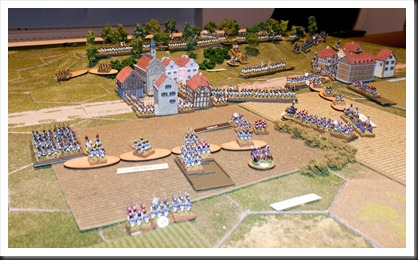
Eckmuhl_Part3002_011613…and is repulsed!

French battalion that stalled in front of the village suffered much worse fate. Unable to move, it was hammered by Austrian fire in following round and promptly routed. They were however not quick enough and after upon taking additional casualties reached the dispersal point and were removed from the field.

Austrians didn’t have it all their way though. In following rounds, the battalion supporting the defenders of the village came under murderous fire from French artillery battery and skirmishers from right flank brigade. They were sent to support the doomed attack on the village, but arrived to late. Now though, they had their chance to take their pound of flesh. For a while I hoped (of course only while I had French general’s bicorne on my head) that the Austrians would break after taking huge casualties. However, due to a rather inventive rules interpretation, I managed to get the exposed unit out of harms way and hide them inside the village just before they reached their dispersal point.
 

Eckmuhl_Part3003_011613French payback!

Net result of the assault on Oberlachling – one ruined French brigade and one Austrian battalion reduced to less than 70 percent of its strength.

Meanwhile, somewhere not far away…

…French light brigade, after forcing opposing artillery battery to retire from the field, slowly advanced toward the main Austrian defensive line which was hiding in the woods covering the heights behind Unterlachling. Deployed in open order, the French were a much harder target to hit than Austrians deployed in massive, but unwieldy lines. Austrian casualties soon started to mount, causing the struck battalion to retreat in panic. For a moment it looked as if French would simply roll up the Austrian flank one battalion at a time.

Eckmuhl_Part3004_011613French light infantry playing hide and seek with the Austrians

This hope/fear was however short-lived – next Austrian battalion that the French encountered delivered a devastating salvo into their opponents, causing one of French units to disperse due to reaching excessive casualties (yes, the dispersion point has been reached). Pressing on with a single battalion, itself already significantly reduced in strength, was pointless. Thus, I had no choice but to recall the remnants of the light brigade back to Unterlachling in following round.

Re-evaluation and decisive actions

Once the action on the high ground behind the villages petered out, I realised that French were in trouble. True, Unterlachling was taken and held in strength, but the brigade holding the left flank was shot to pieces and was by now to weak to accomplish its objective even with help of still fresh Bavarian reinforcements. All those troops now could do was to hold their position and hope that the Austrians didn’t counter-attack.

Of course this was exactly what I decided to do once I exchanged French bicorne for Austrian general’s casket. Task to crush the French brigade was given to the brigade which held the central part of the high ground and which was completely fresh. Its battalions were to move as quickly as possible to the right of Oberlachling and once reaching that position, to decide the day by smashing the enemy in front of them.

Taking the decision wasn’t a problem. Getting the huge Austrian battalions to move was a different matter. It took a lot of time for them to change formation and arrive to their assigned jump-off positions. This allowed for the French to prepare for the onslaught. Artillery was placed in flanking position, lines were straightened out… Nor was it all. Seeing that significant part of Austrian forces holding the heights was now abandoning their positions, I decided for one last desperate French gamble – high ground behind Unterlachling was to be attacked yet again!
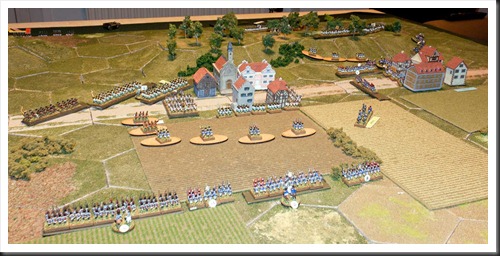
Eckmuhl_Part3005_011613Austrians getting into jump-off position

Eckmuhl_Part3006_011613French forming for yet one more attack on the high ground behind the villages

Thus, the final act of this game consisted of two almost simultaneous assaults on opposing ends of the battlefield. French attack turned almost into a disaster, as two of the three battalions initially refused to charge the Austrian line. Second battalion of 57:th actually failed twice in a row, thus gaining the distinction of failing all three of its charge morale tests in the game – so much for its elite status! Fortunately, its sibling battalion upheld the regimental reputation and swiftly broke its opponents, thus buying time for the rest of French force to recover and dislodge the remaining Austrians from their positions. Both Austrian battalions that broke in this action failed to recover in their subsequent morale check, thus making this desperate assault a complete success!

Eckmuhl_Part3007_011613Vive le Emperor!

Austrian assault offered its own set of surprises, although of different variety. As the brigade dedicated to the task moved forward, I  decided to reinforce it by an additional battalion from the brigade holding the Oberlachling. Following the rules of General de Brigade, to be able to do this I had to create a new brigade, out of necessity commanded by the CinC himself. The problem was that Austrian CinC wasn’t the sharpest tool in the toolbox and completely out of position. Sorting things out took therefore some time, but finally everybody was ready and Austrian columns started to move toward the enemy.

Eckmuhl_Part3008_011613Austrian CinC General Davidovich explains intricacies of chain of command according to General de Brigade to one of his brigade commander

Eckmuhl_Part3010_011613Austrian assault finally on its way with Davidovich leading rightmost batalion in person!

At first sight, Austrian force consisting of three huge line battalions and smaller Carl Erzhog militia unit seemed unstoppable. Bavarians holding extreme left flank of French line took were shot to pieces after putting up short, but spirited resistance. Next, the French battalion previously mauled by Austrian cavalry simply dissolved just before being charged. And then, just as it seemed that the French line would simply fall apart, things started to go wrong for the Austrians. A failed charge morale check for one of the battalions in the middle of Austrian line separated the unit under command of Austrian CinC from the rest of his forces. This unfortunate unit now came under wittering fire from the front as well as from the rear. Extreme French luck with dice not only did turn this unlucky unit into an uncontrollable mob, it also made Austrian CinC to panic, ride off in wrong direction and become captured by somewhat perplexed French infantrymen.

Eckmuhl_Part3011_011613French defence line crumbles…

Eckmuhl_Part3012_011613…and bites back!

Under other circumstances this event could have decided the entire engagement, but not this time though. Neither the unexpected rout of one of Austrian battalions nor loss of their CinC managed to affect the remaining units in noticeable way, which realigned their line and commenced with what can only be described as mopping up of French remnants still present nearby.

Eckmuhl_Part3014_011613

Eckmuhl_Part3015_011613

Situation at the end of the game

All good things…

By that time I’ve played over thirty rounds and was nearing a whooping total of twenty hours playing time. French side had a strong grip on Unterlachling and controlled for the moment the high ground behind the villages. However, the Austrians wiped out one of French brigades and it was easy to see that given time, they had enough troops to win everything they lost by weight of numbers alone. I put the French general’s bicorne on my head and with deep sigh gave orders for general withdrawal. Assault on Lachling villages failed for a second time.